Thank you for your donations to The Society. We will put it to good use to maintain the museum and to educate the people of our region. Donations buttons are located at our main website JAY HISTORICAL SOCIETY
We encourage you to visit our monthly talks in the museum. 6pm, Every second Thursday. We begin with some snacks and have fascinating speakers. You'll meet some great people there too.
You can also SHARE THIS LINK (OUR PAY PAL ACCOUNT) to anyone who wants to donate or buy an item from the society... Just insert the desired amount of payment and method from the directions.
Wednesday, March 6, 2019

JAY HISTORICAL SOCIETY GREETINGS
Thank you for taking the time to look into our Historical Society. Please drop in on Fridays or Saturdays between 10 and 3. You can always email ahead or message us from Facebook to have a volunteer meet you at the museum for a special showing. Groups are encouraged.
(LANDING PAGE FOR DONATION)
(LANDING PAGE FOR DONATION)
Sunday, July 15, 2018
JHS Deluna Bratten
Dr. Bratten's talk on the deLuna wrecks and the archaeology and history that is a gift to Pensacola.


Tuesday, April 10, 2018
Genealogical Society of SR County APR 21
 |
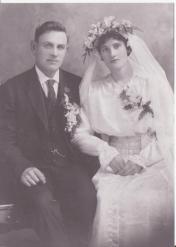
Ida Dena Ranelson & William Gow (standing) |
Our next meeting is on the horizon, and I hope you can attend. Genetic Genealogist, Kristina Clever, will be presenting the program on how to use our DNA data to discover and document our ancestors and relatives. I am very excited about this presentation, and you should be, too. (I have spent more than 30 years searching for the Norwegian parentage of my great grandfather, and my greatest hope is that DNA can help me find who there were and where he was born.) Please come if you can.
We meet at the Santa Rosa County Genealogy Library Building at 10 AM on Saturday, April 21. Sincerely, Gayle Cowley
6275 Dogwood Drive
Milton, FL 32570
(850) 981-READ (7323)
Google Map
Kristina Clever, Genetic Genealogist
Family Tree and DNA Consultant
After listening to my mom’s amazing stories about researching her ancestors, I started researching my paternal family tree in 1986. After interviewing my grandparents, I realized just how little I knew about them and the struggles they had experienced. My grandfather’s dad died when my grandfather was only 9 months old, and my Aunt Shirley was from grandpa’s first marriage.
 |
| Ole Helmer Rude and Olaug Therese Fladaas – Norwegian Immigrants |
My grandmother’s first language was Norwegian, and her mom died when my grandmother was just 5 years old and two of her younger sisters were given up for adoption. I was fascinated and wanted to know more. Who were grandpa’s paternal ancestors? What happened to my grandmother’s younger sisters? How did my ancestors come to the US? What were their lives like? And thus…a hobby was born.DNA and Answers


Continuing the Road to DNA and Family Discovery


I look forward to seeing you on the 21st!
Sincerely, Gayle Cowley
Sunday, March 18, 2018


Friday, March 10, 2017
The Trains and the Stories with Russel Brown
Russell Brown, a member of the Alger-Sullivan Historical Society, presented a program on the History of Escambia County Railroads in the late 1800s. He shared pictures and maps along with a number of interesting "Railroad Stories"

.................................................
A little bit about Alger Loggers
Russell Brown
Alger-Sullivan Historical Society
Printed in Tri-City Ledger – January 12, 2017
The Alger-Sullivan Lumber Company mill at Century was built as cutting edge technology in 1900. The new mill's high volume production would require movement of large shipments of logs and lumber to keep it running.
Trains were the answer, they had been used here to deliver huge long leaf pine logs to saw mills since the 1880s. The Alger mill was built adjacent to the main Louisville & Nashville Railroad line in order to efficiently deliver its products to the port at Pensacola, but the lumber company would need a new railroad into its forests to guarantee a supply of logs.
The Escambia Railway was Alger-Sullivan's railroad. It would operate over 90 miles of main track to access the company's vast forests of south Alabama. The company operated largely with used locomotives, and more than fifty were known to be used by the railway over the years. The railway primarily depended on two types of wood burning steam engines. The Baldwin 2- 6-2 and 2-6-0 locomotives were the main line haulers and the powerful but slower, gear driven Heisler pulled loads on the steeper side routes.
The Escambia Railway route in Alabama was from near Flomaton, northwest to today's Frisco City. From the juncture of several railroads here, it turned east and then northeast, ending east of the town of Monroeville. Along the line were many temporary short-lines. These spurs gave the railway access to the logging areas. Early loggers would then use oxen and mules to haul logs to the closest spur and load them onto rail cars.
By 1920 the steam hoist had been introduced here to load trains. Steam winches called “Donkeys” were also introduced to pull logs from the forests to the loaders. This dragging process did much damage to the forests.
The work of loggers changed little between the nineteenth and early twentieth centuries. Their main tools were the two-man crosscut saw and double bit ax. The work day was usually can to can't. That is to say, from the time you can see in the morning to the time you can't see in the evening. In order to effectively work the forests many miles from town, temporary work camps for the loggers were set up by 1904 on side spurs near the work areas. The camps were established as far north as Monroeville, Alabama and could be at a site for several years. Early camp houses were just boxcars, later ones were not much better. The lumber company would utilize these logging camps for more than fifty years.
The Alger-Sullivan Company saw their forests beginning to be depleted before 1920. In the early 1920's, the company adopted the new idea of replanting the woodlands after timber was cut. It was one of the first logging companies in the U.S. to develop a plan of forest management for the regrowth of timber. The company's plan was to have sustainable forests that would keep the mill operating for 100 years.
The early 1930s saw the introduction of a new tool, the log truck. First intended to replace oxen as a woods transport to the trains, it was quickly discovered that truck operation was very cost effective. Trucks were delivering logs to the saw mill by 1941. At the beginning of World War II many employees left for better paying war-time jobs elsewhere, requiring the company to become more efficient. Before the end of the war, the introduction of stronger trucks, truck mounted hoists, bull-dozers and chainsaws had marked a new era of logging which made the old Escambia Railway obsolete. To help meet the demand for war-time steel, the railroad's last main line tracks were removed in 1945.
Only the Baldwin locomotive Old #100 survived the railways end. Until the mid-1950s it operated as the saw mill's yard engine. It was then retired and put on display with an old company box car in front of the saw mill. In the mid-1970s the locomotive was purchased and rebuilt for the nation's bicentennial celebrations, and through the end of the 1980s it pulled an Indiana tourist train.
The old locomotive was then scrapped and dismantled. Old #100 was later found and purchased by the Alger-Sullivan Historical Society. It was reassembled in Jones Park at Century and today is displayed with the old Alger box car, a last vestige of the Escambia Railway.
:::::::::::::::::::::::::::::::
Trains were the answer, they had been used here to deliver huge long leaf pine logs to saw mills since the 1880s. The Alger mill was built adjacent to the main Louisville & Nashville Railroad line in order to efficiently deliver its products to the port at Pensacola, but the lumber company would need a new railroad into its forests to guarantee a supply of logs.
The Escambia Railway was Alger-Sullivan's railroad. It would operate over 90 miles of main track to access the company's vast forests of south Alabama. The company operated largely with used locomotives, and more than fifty were known to be used by the railway over the years. The railway primarily depended on two types of wood burning steam engines. The Baldwin 2- 6-2 and 2-6-0 locomotives were the main line haulers and the powerful but slower, gear driven Heisler pulled loads on the steeper side routes.
The Escambia Railway route in Alabama was from near Flomaton, northwest to today's Frisco City. From the juncture of several railroads here, it turned east and then northeast, ending east of the town of Monroeville. Along the line were many temporary short-lines. These spurs gave the railway access to the logging areas. Early loggers would then use oxen and mules to haul logs to the closest spur and load them onto rail cars.
By 1920 the steam hoist had been introduced here to load trains. Steam winches called “Donkeys” were also introduced to pull logs from the forests to the loaders. This dragging process did much damage to the forests.
The work of loggers changed little between the nineteenth and early twentieth centuries. Their main tools were the two-man crosscut saw and double bit ax. The work day was usually can to can't. That is to say, from the time you can see in the morning to the time you can't see in the evening. In order to effectively work the forests many miles from town, temporary work camps for the loggers were set up by 1904 on side spurs near the work areas. The camps were established as far north as Monroeville, Alabama and could be at a site for several years. Early camp houses were just boxcars, later ones were not much better. The lumber company would utilize these logging camps for more than fifty years.
The Alger-Sullivan Company saw their forests beginning to be depleted before 1920. In the early 1920's, the company adopted the new idea of replanting the woodlands after timber was cut. It was one of the first logging companies in the U.S. to develop a plan of forest management for the regrowth of timber. The company's plan was to have sustainable forests that would keep the mill operating for 100 years.
The early 1930s saw the introduction of a new tool, the log truck. First intended to replace oxen as a woods transport to the trains, it was quickly discovered that truck operation was very cost effective. Trucks were delivering logs to the saw mill by 1941. At the beginning of World War II many employees left for better paying war-time jobs elsewhere, requiring the company to become more efficient. Before the end of the war, the introduction of stronger trucks, truck mounted hoists, bull-dozers and chainsaws had marked a new era of logging which made the old Escambia Railway obsolete. To help meet the demand for war-time steel, the railroad's last main line tracks were removed in 1945.
Only the Baldwin locomotive Old #100 survived the railways end. Until the mid-1950s it operated as the saw mill's yard engine. It was then retired and put on display with an old company box car in front of the saw mill. In the mid-1970s the locomotive was purchased and rebuilt for the nation's bicentennial celebrations, and through the end of the 1980s it pulled an Indiana tourist train.
The old locomotive was then scrapped and dismantled. Old #100 was later found and purchased by the Alger-Sullivan Historical Society. It was reassembled in Jones Park at Century and today is displayed with the old Alger box car, a last vestige of the Escambia Railway.
:::::::::::::::::::::::::::::::
Subscribe to:
Posts (Atom)